
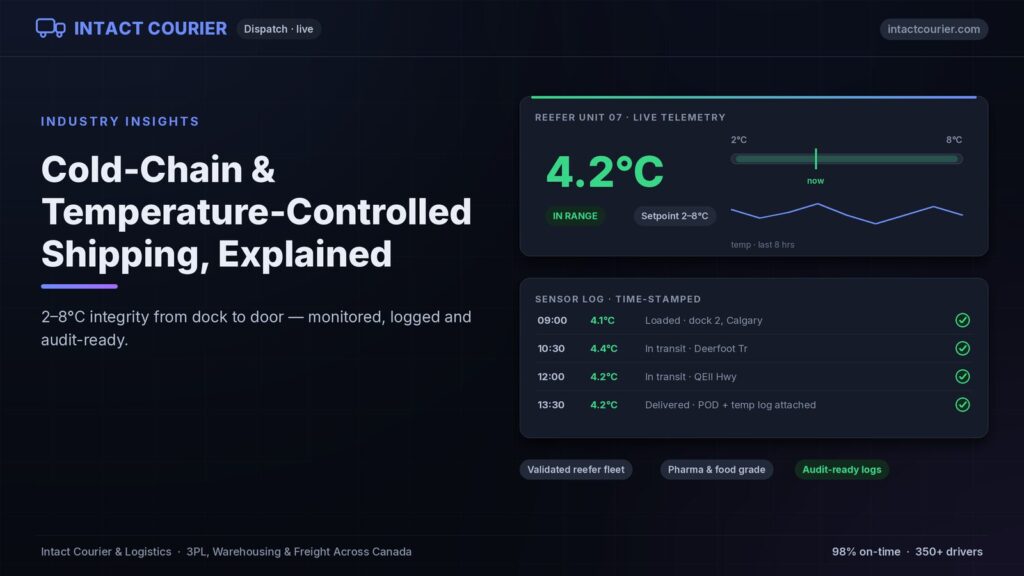
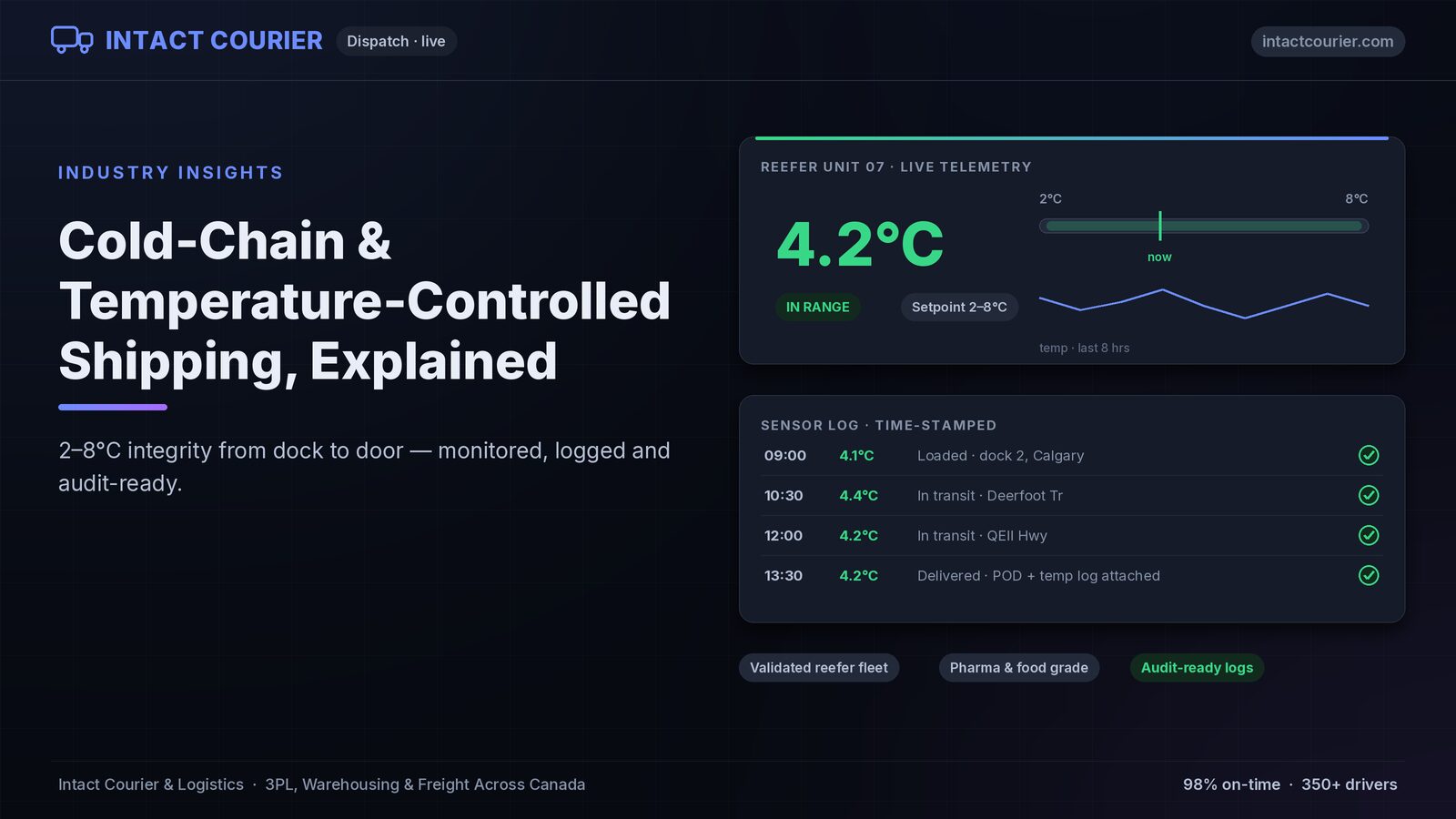
Some freight doesn’t just need to arrive — it needs to arrive at the right temperature. Vaccines, biologics, fresh and frozen food, and many medications are only good if they stayed in range the entire way. That’s cold-chain shipping, and it’s one of the least forgiving jobs in logistics. Here’s how it works.
What is cold-chain shipping?
Cold-chain shipping keeps temperature-sensitive product within a required range from pickup to delivery. There are three common bands: frozen (roughly −25°C to −10°C), refrigerated (2°C to 8°C), and controlled room temperature (15°C to 25°C). The chart above shows what typically moves in each.
What needs cold-chain handling
Anything that degrades outside its range: vaccines and biologics, lab and diagnostic samples, many pharmaceuticals, and fresh or frozen food. For these, temperature isn’t a nice-to-have — a product that drifts out of range can be unusable even if it looks perfectly fine, which is exactly what makes cold-chain risky to get wrong.
How cold-chain integrity is maintained — and why it matters
It comes down to the right equipment and constant monitoring: refrigerated (reefer) units set to the correct band, temperature tracked across the route rather than just checked at pickup, and documented handling so any excursion is caught immediately. Because “it looked fine” isn’t a standard when a patient’s medication or a food-safety batch is on the line, cold-chain is one place where proof and monitoring matter most.
Who actually needs cold chain — and at what range
Refrigerated pharmaceuticals, vaccines and many biologics demand 2–8°C with documented evidence. Fresh food and florals typically ride 0–4°C. Frozen goods need −18°C or colder, and some products (chocolate, cosmetics, certain medical devices) need protection from both heat and freezing — a February problem in Alberta as much as a July one. The product monograph or spec sheet sets the range; the logistics job is holding it for every minute of the journey, not just at loading.
The equipment that holds the range
Three tiers cover most needs: validated insulated totes with gel packs or phase-change material for parcel-scale runs (hours of protection), refrigerated vehicles for route work, and reefer trailers for linehaul. Whatever the tier, two things are non-negotiable — pre-cooling before loading and a calibrated logger travelling with the product. Equipment without monitoring is hope, not cold chain.
The paper trail that makes it compliant
A defensible cold-chain shipment produces: the temperature log from pickup to delivery, calibration records for the loggers, an excursion procedure (who is called, what happens to the product), and proof of delivery tied to the temperature record. Auditors and quality teams ask for exactly these four; a specialized carrier produces them without being asked.
Frequently asked questions
What is cold-chain shipping?
Cold-chain shipping keeps temperature-sensitive product within a required range — frozen, refrigerated, or controlled room temperature — from pickup all the way to delivery.
What products need cold-chain shipping?
Vaccines and biologics, lab samples, many pharmaceuticals, and fresh or frozen food — anything that degrades if it drifts outside its temperature range.
What happens if cold-chain freight goes out of temperature range?
The product can be compromised even if it looks fine, which is why temperature is monitored across the whole route, not just checked at pickup.
What happens if a cold-chain shipment goes out of range?
A documented excursion procedure kicks in: the deviation is flagged, quantified (how far, how long) and reported, and the receiver’s quality team decides disposition against the product’s stability data. Products aren’t automatically lost — but only a logged excursion can be assessed.
Do I need a validated container or a refrigerated truck?
Parcel-scale shipments moving within a day usually ride validated totes with phase-change packs. Multi-stop routes and anything measured in pallets call for refrigerated vehicles. The deciding factors are duration, volume and the consequence of an excursion.
Intact Courier & Logistics is an integrated 3PL, warehousing and freight partner across Canada and the U.S. — same-day, freight, medical and fulfillment under one accountable roof. Get a quote or see our fulfillment services.