
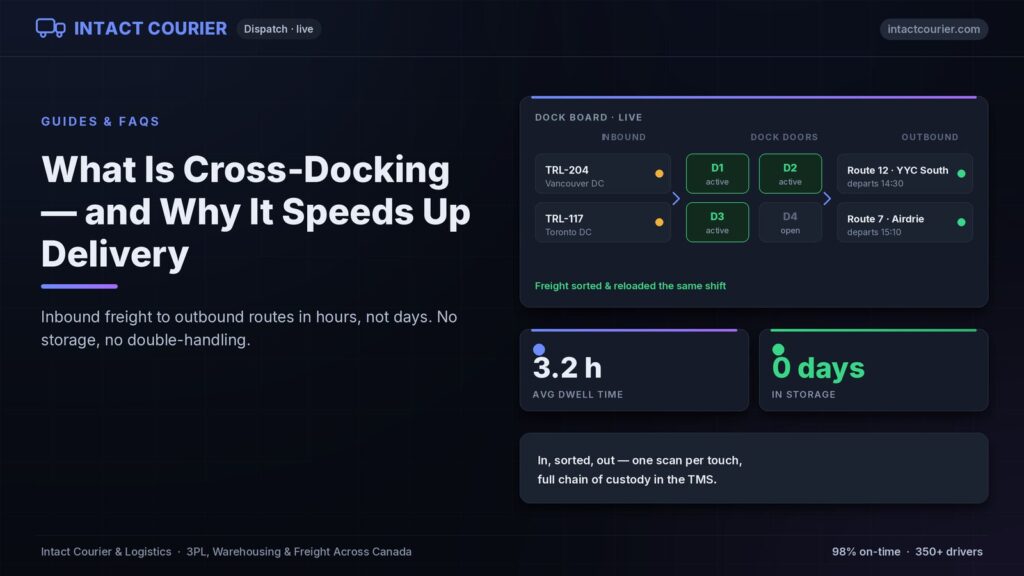
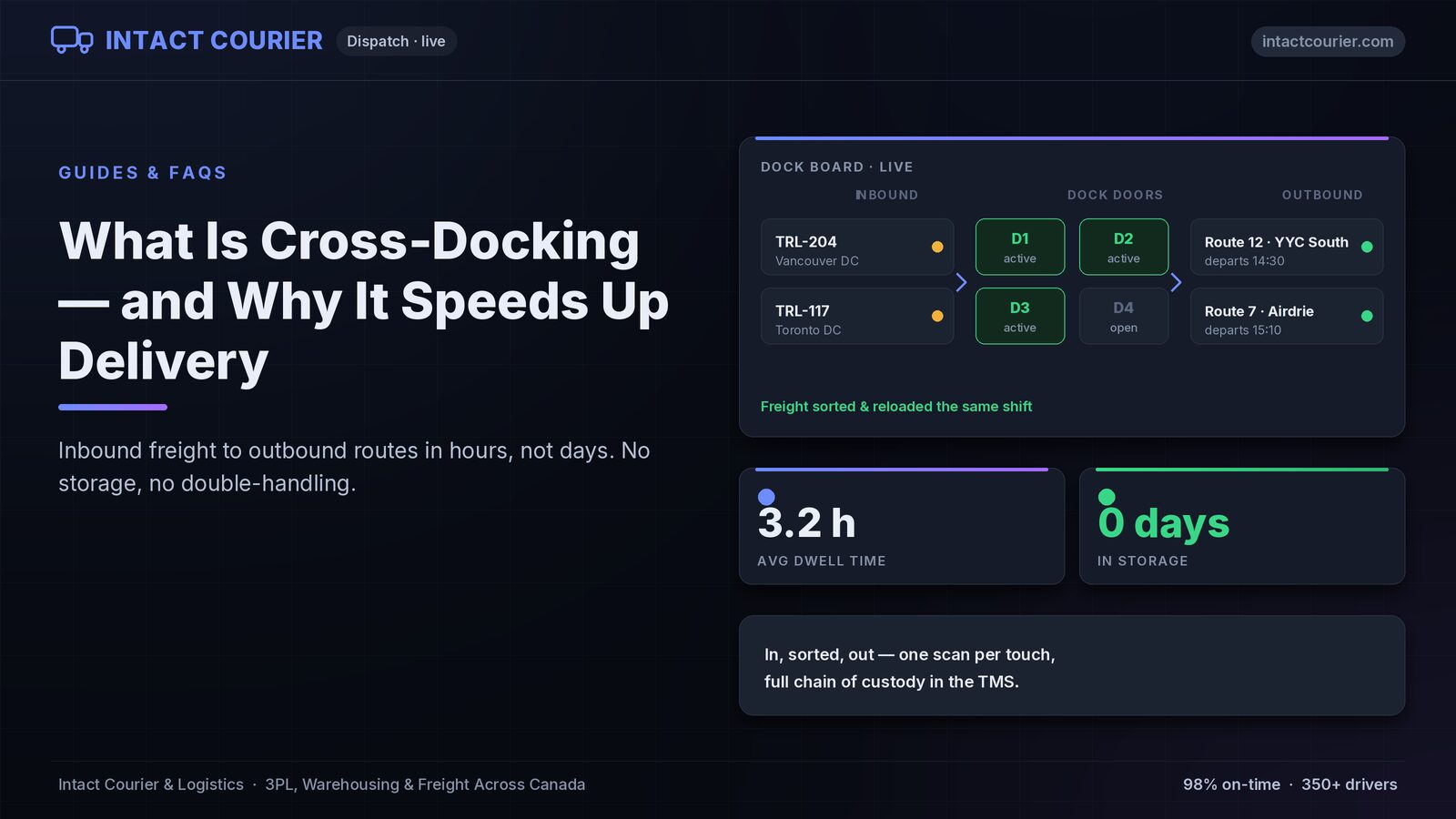
Some of the biggest gains in logistics come from doing less, not more — and cross-docking is a perfect example. Instead of receiving freight, storing it, and picking it later, cross-docking moves it straight from inbound to outbound with little or no storage in between. Here’s how it works and why it speeds up delivery.
What is cross-docking?
Cross-docking is a three-step flow: freight arrives inbound from suppliers or line-haul, gets sorted and staged by route at the dock rather than shelved, and goes straight back out for delivery — often the same or next day. The warehouse becomes a fast-moving relay point instead of a storage building.
Why cross-docking speeds up delivery and cuts cost
Every time freight is put away and picked again, it costs time, labour and a chance for error. Cross-docking removes that middle step: less storage means lower carrying cost, less handling means lower damage risk, and less time on the dock means faster transit end to end. For the right freight, it’s simply a shorter path.
When cross-docking makes sense
It shines for high-volume, time-sensitive, or pre-sorted freight — moving stock between distribution points, consolidating LTL shipments into fuller loads, or getting fast-moving product to stores or customers without a storage step. It needs tight scheduling and a facility built for flow, which is exactly what a cross-dock operation is designed to do.
Cross-dock versus warehouse: the arithmetic
Storage exists to buffer uncertainty; cross-docking exists to remove time. In a warehouse model, freight arrives, is put away, stored, picked and shipped — four touches and days on the clock, each with a cost line. In a cross-dock, inbound freight is sorted directly to outbound routes within hours: one touch, no storage fee, no put-away and pick labour. Whenever demand is known before the freight arrives, cross-docking is simply cheaper and faster.
What kinds of freight suit cross-docking
Pre-sold e-commerce orders arriving from a national DC for local delivery; retail replenishment already allocated to stores; perishables and pharmaceuticals where dwell time is the enemy; and promotional or seasonal surges that would otherwise pay a month’s storage for a week’s need. Poor candidates: unallocated stock, goods needing inspection or rework, and anything whose demand you can’t predict until after arrival.
Setting up a cross-dock flow with your carrier
Three requirements make it work: advance ship notices so the dock knows what’s coming before the trailer opens; carton or pallet labels that map cleanly to outbound routes; and a same-shift departure schedule so sorted freight leaves the building the day it arrives. With those in place, dwell time collapses from days to hours.
Frequently asked questions
What is cross-docking?
Cross-docking moves freight straight from inbound to outbound — sorted and staged by route at the dock rather than stored — so it ships the same or next day.
Why does cross-docking speed up delivery?
It removes the store-and-pick step: less handling, less storage time and a shorter path from arrival to delivery, which cuts both transit time and cost.
When should a business use cross-docking?
For high-volume, time-sensitive or pre-sorted freight — moving stock between distribution points, consolidating LTL loads, or getting fast-moving product out without long-term storage.
How much does cross-docking save compared to warehousing?
You avoid put-away and pick labour and pay hours of dock time instead of weeks of storage. For freight that’s already sold or allocated, total handling cost commonly drops by a third or more, and delivery reaches customers one to three days sooner.
What information does a cross-dock need before my freight arrives?
An advance ship notice: what’s on the trailer, how it’s labelled, and where each unit is going. Clean labelling against that notice is what lets a dock sort inbound freight straight to outbound routes within the same shift.
Intact Courier & Logistics is an integrated 3PL, warehousing and freight partner across Canada and the U.S. — same-day, freight, medical and fulfillment under one accountable roof. Get a quote or see our fulfillment services.