
When you hand freight to a carrier, you’re also handing them your risk. If they cut corners on safety, insurance or compliance, the fallout can land on you. That’s why carrier compliance isn’t paperwork bureaucracy — it’s protection. Here’s what every shipper should verify before hiring a carrier in Canada.
What is CVOR and why it matters
CVOR — Ontario’s Commercial Vehicle Operator’s Registration — is a safety record that tracks a carrier’s collisions, convictions and inspections. Each province has its equivalent safety-fitness certificate under the National Safety Code. A clean record is a direct signal of how a carrier actually operates. If a carrier is cagey about its safety standing, that tells you something.
The carrier compliance checklist
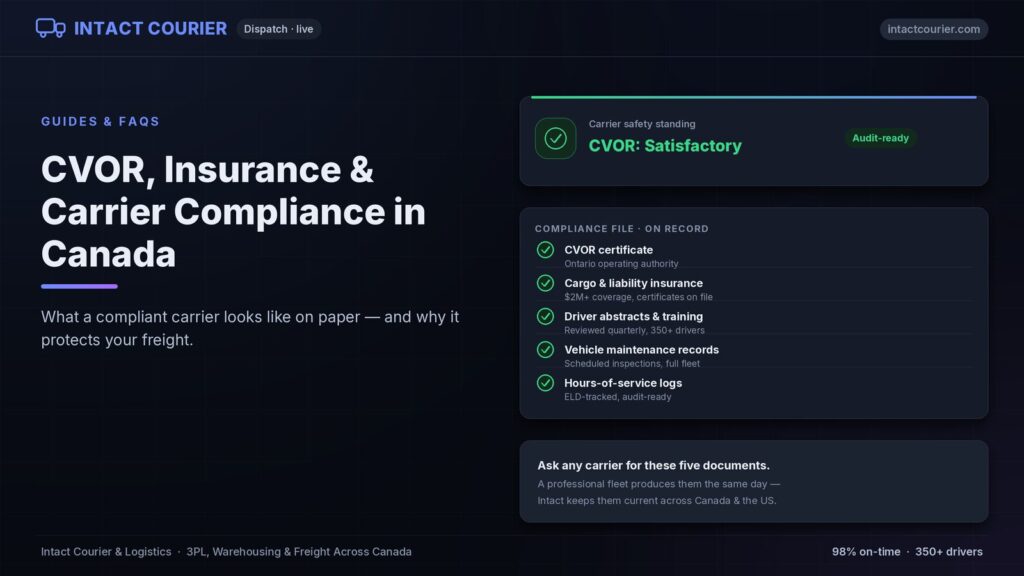
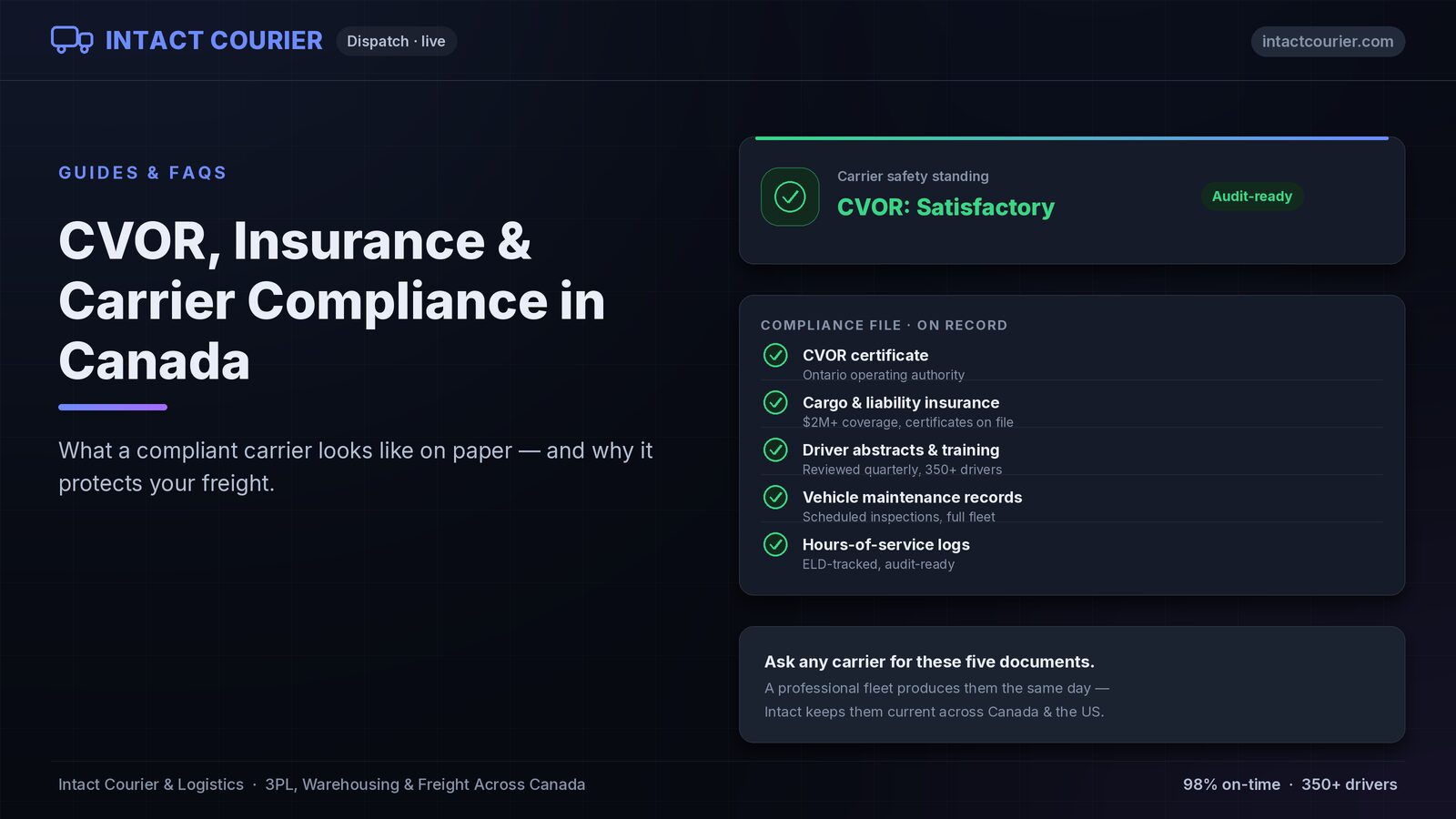
Before you hire, verify the essentials shown above: a clean CVOR or provincial safety record, the correct operating authority for the freight and lanes, adequate cargo and liability insurance, qualified and screened drivers, hours-of-service compliance, and documented, retrievable delivery records. Each one is a place risk hides when it’s missing.
Why compliance protects the shipper, not just the carrier
An uninsured or unsafe carrier’s problem becomes your problem the moment something goes wrong — a damaged load with no coverage, a shipment held because authority was missing, or liability exposure from a collision. Verifying compliance up front is the cheapest insurance you’ll ever buy. Ask for the documents; a real carrier hands them over without hesitation.
What CVOR is — and what it signals
Ontario’s Commercial Vehicle Operator’s Registration is the province’s safety accountability system for truck operators: every inspection, collision and conviction accumulates on the operator’s record, and the ministry rates carriers against thresholds. For shippers, a carrier’s CVOR standing is a free, objective read on how the fleet actually behaves on the road — not how its brochure reads. Alberta’s equivalent safety fitness certificates work similarly out west, and a national carrier maintains clean standing in every jurisdiction it runs.
The insurance numbers that actually matter
Two lines protect you: commercial general liability (typically $2M+ for serious carriers) and cargo insurance sized to what your freight is actually worth per load. Ask for certificates naming current dates, and note the cargo deductible and exclusions — a $100k cargo policy with a fine-print exclusion for theft from unattended vehicles is worth much less than it appears. Healthcare, dangerous goods and high-value electronics all justify asking for higher limits.
The five-document test for any carrier
Before you hand a carrier your freight, request: their CVOR abstract (or provincial equivalent), certificates of insurance, driver hiring and abstract-review standards, vehicle maintenance program evidence, and hours-of-service compliance method (ELDs). A professional operation produces all five within a business day. Hesitation on any of them is the cheapest red flag you’ll ever receive.
Frequently asked questions
What is a CVOR?
CVOR is Ontario’s Commercial Vehicle Operator’s Registration — a safety record tracking a carrier’s collisions, convictions and inspections. Other provinces have equivalent safety-fitness certificates under the National Safety Code.
What should I check before hiring a carrier in Canada?
A clean CVOR or provincial safety record, correct operating authority, adequate cargo and liability insurance, qualified drivers, hours-of-service compliance, and documented delivery records.
Why does carrier compliance matter to shippers?
Because an unsafe or uninsured carrier’s problems become the shipper’s — damaged loads with no coverage, held shipments, or liability exposure. Verifying compliance up front protects you.
What is a CVOR certificate and who needs one?
Ontario requires a CVOR for operators of trucks over 4,500 kg registered gross weight. It tracks the operator’s on-road safety record — inspections, collisions, convictions — and the ministry can sanction operators whose violation rate climbs too high.
How much insurance should a courier or freight carrier have?
Look for commercial general liability of $2M or more plus cargo coverage sized to your typical load value, with current certificates you can verify. High-value, healthcare or dangerous-goods freight warrants higher limits and explicit confirmation of exclusions.
Intact Courier & Logistics is an integrated 3PL, warehousing and freight partner across Canada and the U.S. — same-day, freight, medical and fulfillment under one accountable roof. Get a quote or see our fulfillment services.