
When a package goes missing, most people count the value of what was inside. That’s the smallest part of the bill.
The real math
One lost delivery is rarely one cost. It’s a stack:
- The item — replaced or refunded.
- The refund or credit to the customer.
- The chargeback from the client or platform.
- The support time spent chasing it.
- The customer who never orders again — the most expensive line, and the one nobody puts on the invoice.
Add it up and a “cheap” delivery that saved fifty cents can quietly cost a couple hundred dollars. Multiply that across a busy month and the cheapest carrier becomes the most expensive decision you made all year.
Why proof-of-delivery changes the game
Most disputes aren’t about theft. They’re about ambiguity — “it never arrived” versus “yes it did,” with no evidence either way. Ambiguity always costs the carrier and the shipper.
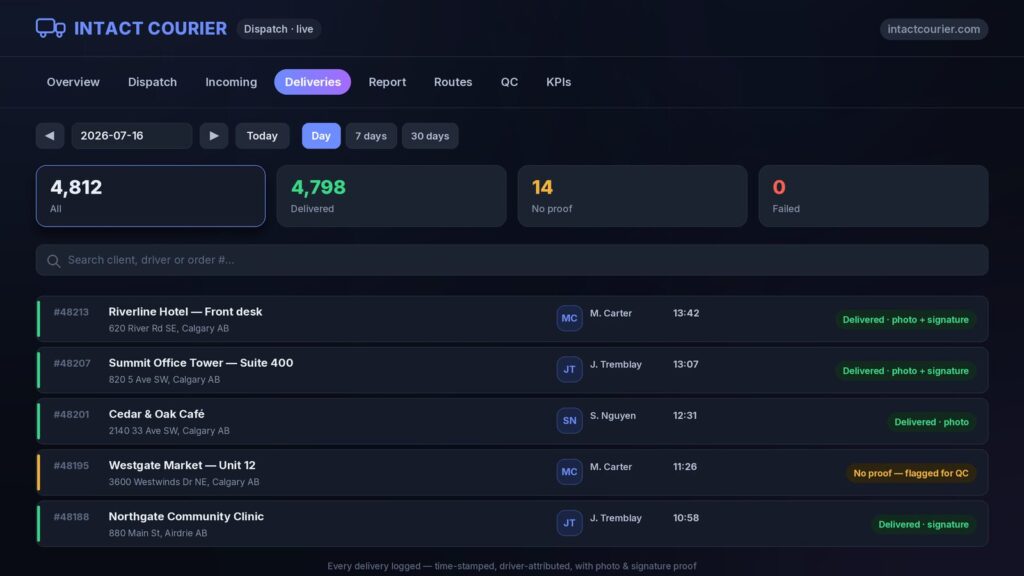
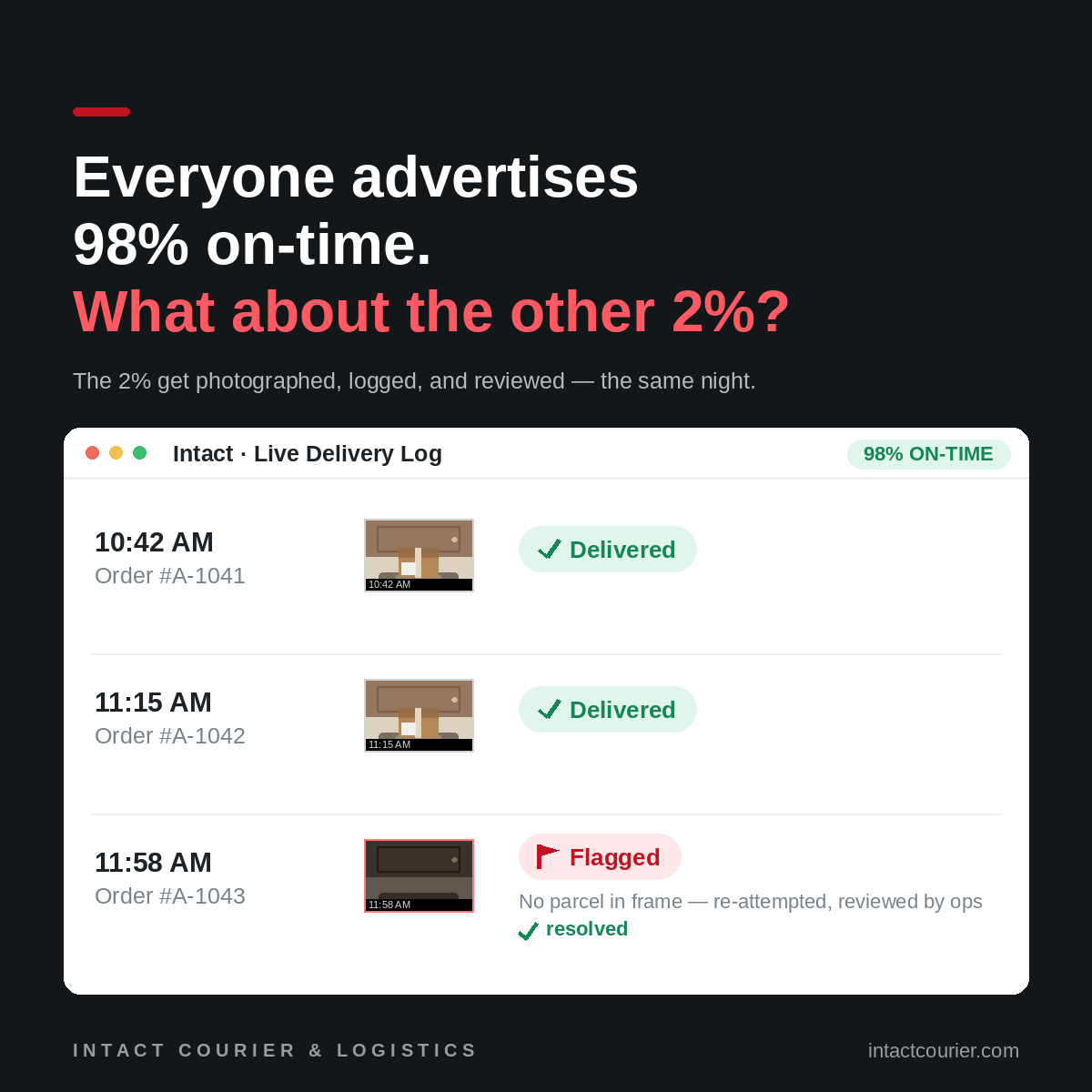
Photographed, timestamped proof-of-delivery removes the ambiguity. A clear photo of the parcel at the door or the front desk, with a time on it, ends most disputes before they start. We’ve kept contracts on the strength of a single 11:42am photo.
Proof is only as good as its quality
A blurry, dark, or parcel-less photo protects no one. That’s why we grade every POD photo — automatically, every night. If an image is unusable, it gets flagged and followed up while the memory is fresh, not three weeks later when a chargeback lands.
The takeaway
You can’t eliminate every failed delivery. But you can make every delivery provable. The carriers who invest in that don’t just lose fewer packages — they win more disputes, keep more contracts, and cost you less over time.
Cheap carriers don’t track this. Because if they did, they couldn’t sell “cheap.”
What a real chain of custody looks like
A shipment that can’t go missing quietly is one that is scanned at every handoff: at pickup, at any cross-dock or depot, on the delivery vehicle, and at the door. Each scan records who touched the package, where and when. When a customer calls asking where their order is, the answer is a timeline, not a search party. That is the difference between a courier with a tracking page and a courier with a chain of custody.
The hidden costs nobody budgets for
The replacement product is the smallest part of a lost package. Add the reshipment cost, the support time spent investigating, the chargeback if the customer disputes the sale, and the quiet cost that never shows on an invoice: a customer who doesn’t order again. Retail studies consistently put the true cost of a failed or lost delivery at several multiples of the shipping fee. For a business doing hundreds of orders a month, even a 1% loss rate compounds into real money and real churn.
How photo and signature proof ends disputes before they start
Most delivery disputes aren’t fraud — they’re ambiguity. A time-stamped photo of the package at the door, or a signature captured on the driver’s device, removes the ambiguity. Chargebacks get answered with evidence in minutes. “It never arrived” conversations become “it was received at 2:41 p.m. by the front desk” conversations. Proof of delivery isn’t paperwork; it’s the cheapest insurance a shipper can carry.
Frequently asked questions
What happens if a courier loses my package?
A reputable courier traces it, tells you honestly, and covers the loss through insurance or credit. The real protection is timestamped, photographed proof of delivery that removes ambiguity in the first place.
What counts as valid proof of delivery?
A clear, timestamped photo showing the parcel at the delivery point — a doorstep, reception desk or dock — ideally reviewed for quality so blurry or empty photos are caught and re-attempted.
How does proof of delivery protect my business?
It ends ‘it never arrived’ disputes before they start, protects you from chargebacks, and preserves contracts by proving exactly what was delivered, where and when.
What should proof of delivery include?
Strong proof of delivery includes a time-stamp, GPS location, the recipient’s name or signature, and a photo of the package where it was left. Together these answer who received it, where and when — enough to resolve almost any dispute or chargeback.
Who is liable when a courier loses a package?
The carrier is generally liable up to its declared-value or insurance limit, which is why reputable couriers publish claims processes and carry cargo insurance. Ask any courier what their claim turnaround is and what documentation they provide — a professional fleet answers immediately.
Intact Courier & Logistics runs same-day, freight, medical and 3PL delivery across Calgary, Vancouver, Edmonton, Winnipeg, Toronto and Montreal. Talk to our team or explore our fulfillment services.