
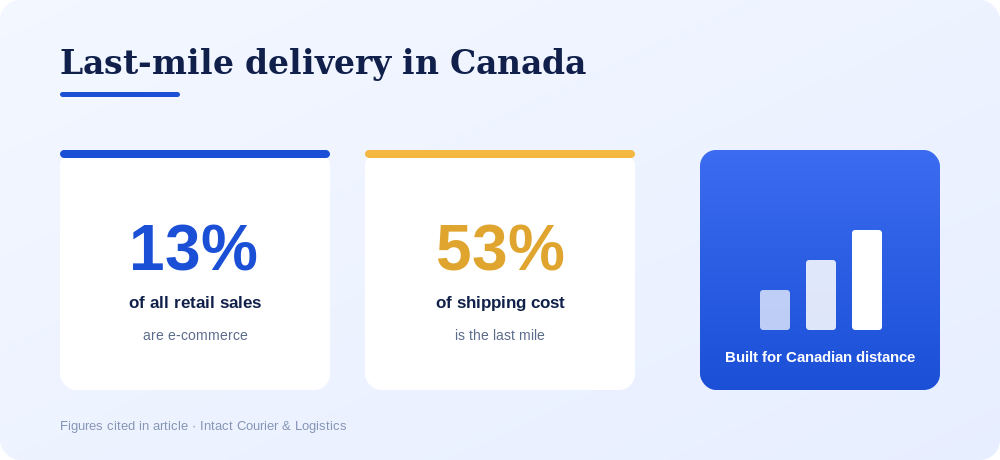
The way Canadians receive goods is changing faster than at any point in the past decade. E-commerce now drives roughly 13% of all retail sales in Canada (eMarketer), customer expectations have hardened around speed, and the economics of the final mile are under real pressure. Here is an honest look at the state of last-mile delivery in Canada heading through 2026 — and what it means for businesses.
Speed is now the default expectation
Same-day delivery has moved from premium perk to baseline expectation. Today 80% of consumers expect retailers to offer same-day delivery, 68% are more likely to shop online when it is available, and among 18–34-year-olds, 56% simply expect it (Capital One Shopping). The global same-day market is forecast to grow from about US$18 billion in 2025 to nearly US$83 billion by 2033. For Canadian businesses, “ships in 5–7 days” is increasingly a competitive liability.
The last mile is the cost battleground
That speed comes at a price. The final mile now represents around 53% of total shipping costs, up from 41% in 2018, and delivery costs rose roughly 12% in a single year from 2024 to 2025 (SmartRoutes). It is no surprise that 85% of retail executives name cutting cost-per-order their top priority. The central tension of 2026: customers want it faster and cheaper at the same time.
How businesses are responding
- Distributed inventory: storing stock in regional warehouses closer to customers to shorten the last mile.
- Local courier partnerships: working with regional same-day couriers who know the city instead of relying solely on national carriers.
- Real-time visibility: tracking that cuts failed deliveries and support costs.
- Vendor consolidation: bundling freight, fulfilment, and delivery for volume pricing and single-point accountability.
The Canadian wrinkle: geography and weather
Canada’s vast distances, dispersed population, and harsh winters make the last mile uniquely challenging here. Strategies copied from dense U.S. or European markets often break down. Local knowledge — of routes, conditions, and neighbourhoods — is a genuine competitive advantage, not a nice-to-have.
What it means for your business
The takeaway is not “spend more on delivery.” It is “design delivery deliberately.” Businesses that position inventory locally, partner with couriers who know their markets, and consolidate vendors are absorbing rising costs while still meeting fast-delivery expectations. Those who treat the last mile as an afterthought will feel the squeeze from both directions.
Frequently asked questions
Why are last-mile costs rising?
Labour (about half of last-mile cost), fuel, failed-delivery re-attempts, and rising customer expectations for speed are all pushing costs up.
Is same-day delivery worth offering?
For most retailers, yes — it directly influences purchase decisions, and most shoppers will pay a small premium for it.
How can smaller businesses compete on delivery?
By storing inventory locally and partnering with regional couriers, smaller players can match — or beat — national carriers on local speed.
Get a Free Quote
Want a last-mile strategy built for Canadian realities? Contact Intact Courier & Logistics for a free consultation on faster, more cost-effective delivery.