
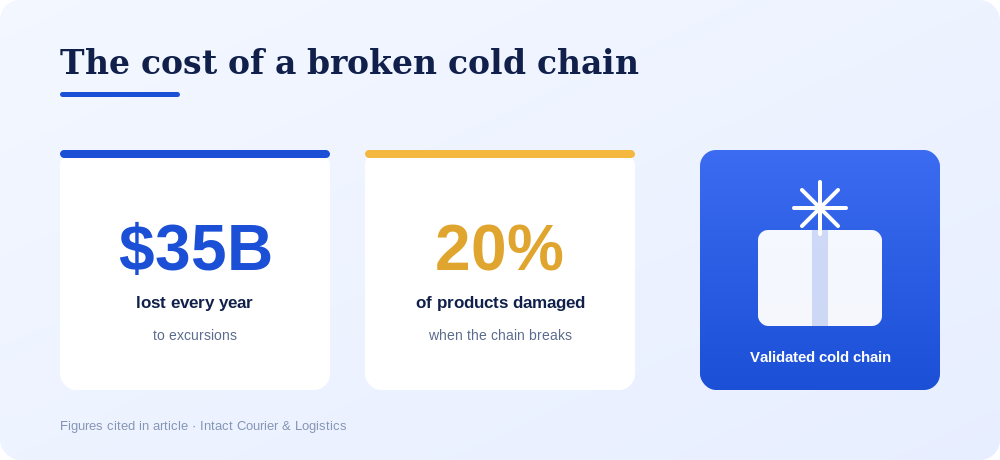
From vaccines and biologics to fresh food and lab specimens, temperature-sensitive goods share one unforgiving rule: stay within range, or lose the product. The stakes are enormous. Temperature excursions cost the pharmaceutical sector alone an estimated USD $35 billion every year, and around 20% of temperature-sensitive products are damaged in transit (DataM Intelligence). Whether you ship medication, diagnostics, or perishables, here is how cold-chain logistics actually works — and how to avoid costly losses.
What “cold chain” really means
A cold chain is an unbroken sequence of temperature-controlled storage and transport, from origin to final destination. “Unbroken” is the operative word: a shipment can sit perfectly in a fridge for days and still be ruined by twenty minutes on a hot loading dock. The chain is only as strong as its weakest hand-off.
The four pillars of a reliable cold chain
- Validated packaging: insulated containers and the right coolant (gel packs, dry ice, or phase-change materials) matched to the product and transit time.
- Temperature monitoring: data loggers or real-time sensors that prove the product stayed in range — and flag the moment it did not.
- Trained handlers: drivers who understand load times, dwell time, and why a package cannot be left in a warm vehicle.
- Speed and routing: the faster and more direct the route, the less thermal risk accumulates.
Why excursions happen — and what they cost
Most excursions are not equipment failures; they are handling and timing failures. Delays, extra hand-offs, extreme weather, and packages left on docks are the usual culprits. The cost is rarely just the product: the average investigation into a single damaged-goods incident runs around USD $7,000 before replacement and downstream impact. For clinical trials, where tolerance can sit below 1%, one mishandled leg can compromise an entire study.
Best practices that prevent losses
Match packaging to the longest realistic transit time, not the average. Minimize hand-offs by using a single accountable carrier. Pre-cool vehicles and containers. Monitor every shipment so you have proof of compliance and an early warning system. And build in time buffers for weather — Canadian winters and summers both threaten the chain from opposite directions.
Getting it right with a specialized partner
General parcel carriers are not built for this. A dedicated healthcare and temperature-controlled logistics provider brings validated handling, monitoring, and chain-of-custody documentation as standard. Intact Courier has moved time- and temperature-sensitive shipments since 2018 with a 98% on-time record, fully insured and supported by a broader same-day courier network across Canada.
Frequently asked questions
What products need a cold chain?
Vaccines, biologics, many medications, diagnostic specimens, certain foods, and some chemicals — anything with a defined safe temperature range.
How do you prove the cold chain stayed intact?
Temperature data loggers or real-time sensors record the shipment’s conditions end to end, providing documented proof for compliance.
What is the most common cause of cold-chain failure?
Handling and timing — delays, extra hand-offs, and packages left in warm or cold environments during transfers — far more often than equipment failure.
Get a Free Quote
Shipping temperature-sensitive goods? Contact Intact Courier & Logistics for a free quote on validated, monitored cold-chain delivery.