
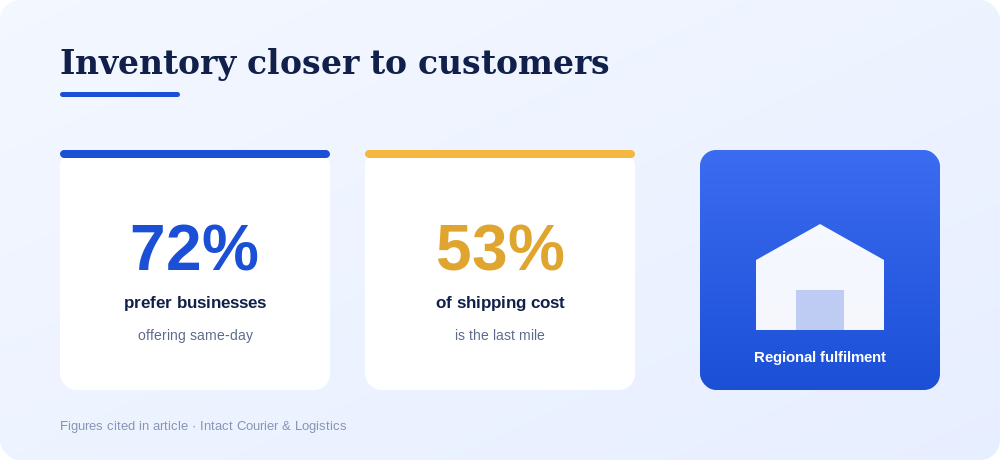
For years, the centralized mega-warehouse was the gold standard of e-commerce fulfilment: one big building, maximum efficiency, ship everything from there. That model is now being quietly dismantled. As same-day expectations harden — 80% of consumers expect it and 72% prefer businesses that offer it (Capital One Shopping) — and last-mile costs climb to 53% of total shipping spend, Canadian retailers are moving inventory closer to the customer. Here is why, and what it means for how goods move across the country.
The math behind decentralization
A parcel shipped from a single central warehouse to the far side of the country travels a long, expensive last mile. Split that inventory across regional facilities and the final leg shrinks dramatically — cutting cost and transit time at once. When the last mile is the majority of delivery cost, shortening it is the highest-leverage move a retailer can make.
What distributed fulfilment unlocks
- Same-day reach: local stock makes same-day and next-day delivery economically viable in each market.
- Lower shipping costs: shorter routes reduce per-order spend across the board.
- Resilience: a weather event or disruption at one node no longer halts the entire operation.
- Better customer experience: faster, more predictable delivery in every region you serve.
Canada’s geography makes the case stronger
In a country this large, a single warehouse simply cannot serve Vancouver, Toronto, and Montreal quickly or cheaply. Retailers are increasingly positioning inventory regionally and pairing it with local couriers who know each market — enabling same-day delivery in Vancouver, Toronto, and Montreal from stock held nearby rather than shipped across provinces.
Beyond parcels: bulky and specialty goods
The shift matters even more for large items. Local capacity makes services like white-glove appliance delivery practical, where shipping oversized goods long distances would be prohibitively expensive and slow. Regional fulfilment turns “available in 1–2 weeks” into “delivered this week.”
How to make the move without the overhead
You do not need to build and staff warehouses in every city. Partnering with a logistics provider that already operates regional warehousing and delivery — or stepping into a full 3PL relationship — gives you distributed fulfilment as a service. Intact Courier has helped Canadian retailers position inventory closer to customers since 2018, backed by 350+ drivers and a 98% on-time record.
Frequently asked questions
What is distributed fulfilment?
Storing inventory in multiple regional locations rather than one central warehouse, so orders ship from the facility closest to each customer.
Does my business need multiple warehouses to do this?
No. A 3PL with regional facilities lets you achieve distributed fulfilment without building or leasing your own buildings.
How much can regional fulfilment save?
Savings vary, but because the last mile is the majority of shipping cost, shortening it through local stock can reduce delivery cost-per-order significantly.
Get a Free Quote
Thinking about moving inventory closer to your customers? Contact Intact Courier & Logistics for a free consultation on regional warehousing and same-day delivery.