
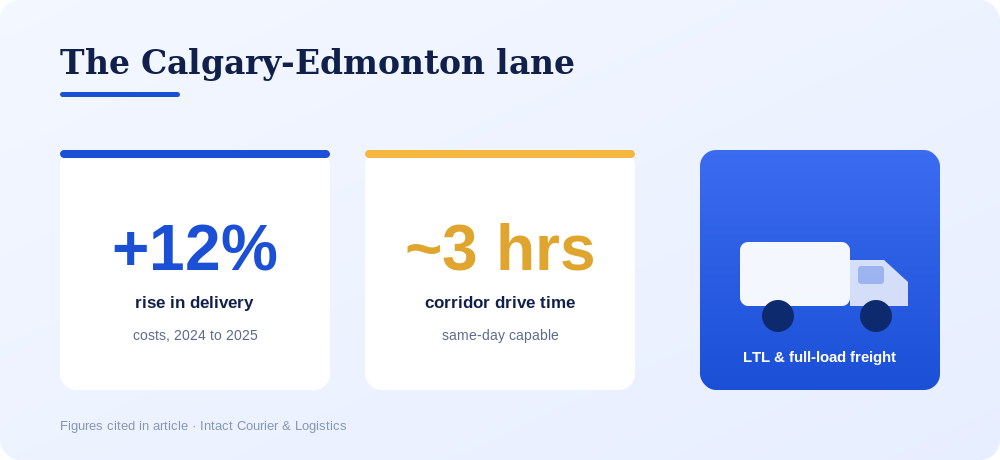
The Calgary–Edmonton corridor is one of the busiest freight lanes in Western Canada, linking two metros and roughly three million people along the QEII Highway. Whether you are moving a few pallets or a full trailer, understanding your options helps you balance cost against speed — which matters more than ever, given that last-mile and delivery costs rose about 12% from 2024 to 2025 and now represent the largest share of total shipping spend (SmartRoutes). Here is how businesses approach freight transport along the corridor.
LTL vs full-trailer: which to choose
Less-than-truckload (LTL) shipping lets you pay only for the trailer space your pallets occupy, sharing the truck with other shippers. It is cost-effective for smaller loads but can add time for consolidation. Full-truckload (FTL) gives you the entire trailer — faster, more direct, and gentler on fragile freight because it is not repeatedly handled.
- LTL: best for 1–6 pallets where cost matters more than raw speed.
- FTL: best for large volumes, fragile goods, or tight deadlines.
- Dedicated linehaul: scheduled runs for businesses that ship the corridor regularly and want predictable capacity.
Transit times along the QEII
The drive between the two cities is roughly three hours, so a direct full load can move the same day. LTL may take a day longer depending on consolidation and the carrier’s schedule. The biggest variable is rarely the highway itself — it is the handling on each end. Building a predictable schedule with a single carrier removes guesswork and lets you promise reliable dates to your own customers.
Connecting freight to last-mile
The largest efficiency gain comes from pairing linehaul with local delivery on both ends. When the same partner moves your freight along the corridor and handles final-mile delivery in Calgary and Edmonton, your shipment stays with one accountable team from dock to doorstep — no inter-carrier hand-offs, no lost-shipment finger-pointing. For businesses moving regular volume, folding freight into a broader 3PL arrangement consolidates warehousing, linehaul, and delivery under one agreement.
Intact Courier has operated since 2018 with 350+ professional drivers and a 98% on-time record, and is fully insured and CVOR-certified for freight moves across Alberta and beyond.
How to control freight costs
With shipping costs climbing, a few habits keep your corridor spend in check: consolidate shipments to fill trailers, schedule recurring runs to lock in capacity and rates, and work with a single partner across linehaul and last-mile to earn volume pricing rather than paying retail to multiple carriers.
Frequently asked questions
How long does freight take between Calgary and Edmonton?
A direct full-truckload can move the same day given the roughly three-hour drive; LTL shipments may take an additional day depending on consolidation.
Should I use LTL or full-truckload?
Choose LTL for small loads where cost is the priority, and full-truckload for large, fragile, or time-sensitive freight.
Can you handle both the linehaul and local delivery?
Yes. Intact moves freight along the corridor and completes last-mile delivery on both ends, keeping your shipment with one accountable partner.
Get a Free Quote
Moving freight along the Calgary–Edmonton corridor? Contact Intact Courier & Logistics for a free quote on LTL, full-truckload, or dedicated scheduled linehaul.